

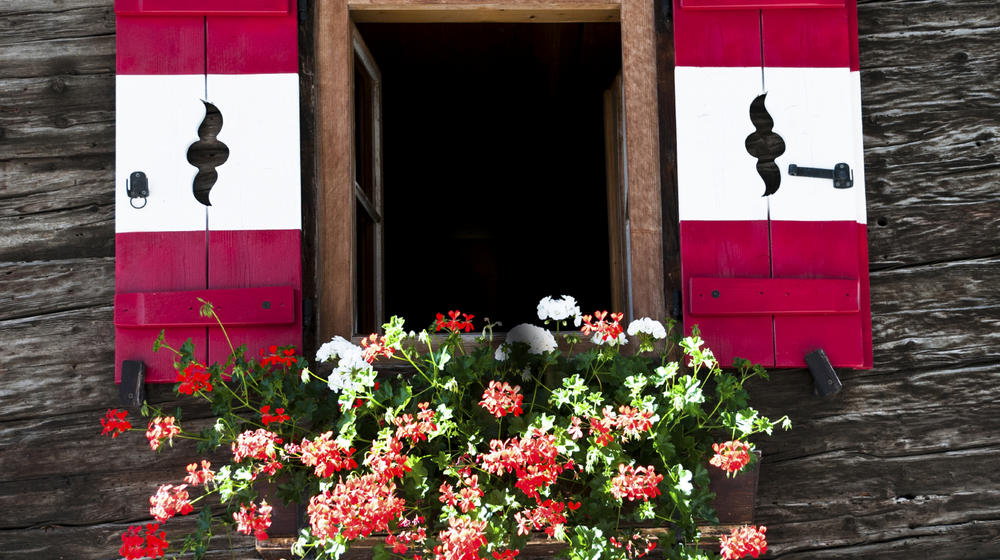
Austria is a beautiful country. Many claim this. Mountains, lakes, rivers, and cities can be found almost everywhere. So what makes Austria so special? To answer this question, we will explore the country from a new perspective—using all five senses.
HEARING
In Austria, there is much beauty to be heard. Unforgettable is the classical music of its composers, still played around the world today. Distinctive are its dialects, which Austrians speak with pride and pass down through generations. Nostalgic is the sound of horses’ hooves pulling carriages through historic city centers. But let us now leave the lively cities behind and step into the realm of nature. In Austria, one can hear the unique natural sounds of the highest waterfalls in Europe: the Krimml Waterfalls in the Hohe Tauern National Park. With a total drop of 380 meters, the water cascades down three tiers into the valley. These waterfalls are not only loud and impressive, but also recognized as a natural remedy for allergies and asthma. For this purpose, an aerosol inhalation therapy area has been established directly at the foot of the Krimml Waterfalls.
The mountainous regions of western Austria are also the homeland of yodeling. As early as the 17th and 18th centuries, people yodeled to communicate from hill to hill. In the 19th century, yodel songs experienced a real boom, and Tyrolean songs with yodeling parts became popular all over the world. This form of Alpine music is still widespread today, and it remains an extraordinary experience to encounter a singing yodeling group during a hike or in a mountain restaurant. Yodeling is often accompanied at folk festivals by the Alpine dance of the Schuhplattler. The rhythmic slaps on thighs, calves, and shoes produce characteristic sounds often associated with the region of Tyrol.
Here we have summarized a few ways in which Austria can be recognized through hearing: through its music, its songs, its language, its past, and the sounds of nature. The further search for other homeland sounds is up to you…
SMELL
“Shortly afterward, feeling depressed by the gloomy day and the prospect of a sad tomorrow, I raised to my lips a spoonful of tea in which I had soaked a morsel of madeleine cake. (…) A sensation of extraordinary happiness, whose cause was unknown to me, had invaded me.” — Marcel Proust in his famous novel *In Search of Lost Time*. In this case, the smell of the pastry combined with the taste of the tea evokes memories in the narrator. In fact, smells can trigger memories more than any other sense, because they are directly perceived by the brain areas responsible for memory and emotion.
If Proust had been Austrian, what might have triggered memories in his protagonist? Probably a *Melange* with a slice of *Sachertorte*. Austria’s coffee culture is indeed very pronounced. In 2019, Austria ranked 5th among European countries in coffee consumption. According to the Austrian Coffee Association, each Austrian drinks an average of 1,000 cups of coffee or 145 liters per year. Coffee is therefore more popular than water and beer. The affection for this hot beverage is primarily due to the aroma of coffee, followed by the aspect of coziness (De’Longhi Coffee Report 2018). This explains why coffee houses are so popular in Austria. In total, there are more than 14,000 coffee establishments in Austria.
Especially in Vienna, coffee house culture has a long tradition. The first Viennese coffee house was opened in 1685 on today’s Rotenturmstraße. Until the mid-19th century, coffee houses were accessible only to men. Over the years, they developed into meeting places for writers, artists, and later for politicians and journalists. Since 2011, Viennese coffee house culture has been part of UNESCO’s Intangible Cultural Heritage. The justification reads: “The coffee houses are places where time and space are consumed, but only the coffee appears on the bill.”
As for coffee itself, more than 40 different coffee creations are currently offered in Austria. Nevertheless, Austrians’ favorite coffee specialties remain the classic cappuccino, espresso, and milk coffee. It’s no wonder that coffee—with its tradition, variety, and especially its distinctive aroma—has been crowned Austria’s favorite beverage.
Events related to coffee: October 1, 2020 – International Coffee Day; January 15–17, 2021 – Vienna Coffee Festival.
TASTE
What tourists absolutely want to eat in Austria are mainly three dishes: Wiener Schnitzel, sausages, and Sachertorte. But Austrian cuisine offers much more. It is literally a symphony of taste. It begins with soups in various recipe variations, continues with meat dishes influenced by neighboring countries’ cuisines, and ends with a variety of sweet pastries. Since 2019, Austria’s pastry culture has been declared a UNESCO World Heritage and included in the register of “Good Practices for the Preservation and Transmission of Intangible Cultural Heritage.”
We also owe today’s variety of pastries to the church fasting periods. In the past, Catholics had up to 130 days a year when meat consumption was prohibited. Fish was allowed but expensive. Over time, some mammals, birds, and even beavers (due to their tails) were reclassified as fish by believers… and they began preparing increasingly creative pastries that were served as main courses. Thus, meals were created that the whole world envies today.
In terms of taste, Austria has shined since last year with a new entry in the Guinness Book of Records: in Allhaming, Upper Austria, the Wenschitz Praline World opened in mid-April 2019 with the tallest chocolate fountain in the world. The 12.3-meter-high artwork with heated cascades and flowing edible chocolate took first place, followed by the chocolate fountain at the famous Bellagio Hotel in Las Vegas.
SIGHT
Austria’s sights are numerous, and many are flooded by mass tourism. Since 2017, Austria has ten UNESCO World Heritage Sites: the historic centers of Vienna, Graz, and Salzburg; the Schönbrunn Palace and Park; the cultural landscapes of Hallstatt-Dachstein/Salzkammergut, Wachau, and Fertö-Neusiedlersee; the Semmering Railway; the prehistoric pile dwellings around the Alps; and the ancient beech forests in the Kalkalpen National Park and the Dürrenstein Wilderness Area.
But Austria also offers many places that are not yet tourist hotspots. Among them, the Highline179 suspension bridge in Tyrol is worth a visit. This impressive steel bridge was, until recently, listed in the Guinness Book of Records as “the longest pedestrian suspension bridge in Tibet style” with its 146 meters. A walk on Highline179 (named after the B179 federal road below), at a height of up to 114.6 meters, offers thrills even for those without fear of heights. The challenge of crossing the bridge despite its height and swaying is rewarded with a breathtaking view.
For those who prefer to avoid the heat, we recommend a trip to the Eisriesenwelt in Werfen, Salzburg. With an ice surface of 20,000 square meters and a length of 42 kilometers, the Eisriesenwelt is the largest ice cave in the world. Even in summer, temperatures here usually remain below zero degrees—ideal for escaping a hot summer day. The colors of the ice, the magical formations, and the impressive dimensions of the cave are a natural spectacle not to be missed.
One final tip for those who want to see something truly special in Austria is a natural gem called the “dicke Oachn.” That’s what the locals call the oldest oak tree in Europe. The 1,000-year-old tree grows near Bad Blumau in Styria. The oak has reached an impressive height of about 30 meters, a crown diameter of around 50 meters, and a trunk circumference of more than 8 meters. Visiting it is free and absolutely worthwhile. You can even recharge your energy and find a bit of peace at the base of this ancient oak.
TOUCH
Our journey to experience something extraordinary in Austria through the sense of touch begins in the village of Schröcken in Vorarlberg. From here, a hiking trail leads to a magical nature reserve after about 45 minutes. Surrounded by meadows, trees, and mountains lies the Körbersee at an altitude of 1,656 meters, which was voted Austria’s most beautiful place in the ORF show “9 Places, 9 Treasures” in 2017. This lake is not only beautiful but also cold: even on hot summer days, the water temperature remains around 14 degrees. A swim in the Körbersee is the perfect opportunity to awaken the sense of touch.
Our journey continues in search of tactile experiences toward Carinthia. In the romantic setting of the Tscheppaschlucht in Ferlach, there is a 300-meter-long barefoot trail with a water section. A walk along this path is a delightful tactile experience, providing a natural foot massage and a regenerating effect.
The positive effect of nature on the body is ancient wisdom. A 2019 study by the University of Michigan (USA) scientifically proved that just 20 minutes in nature lowers the hormone cortisol. This stress hormone can cause illnesses such as depression, obesity, sleep disorders, and cardiovascular problems over time. The Kalkalpen National Park, with its ancient beech forests and primeval beech woods, is the ideal terrain for nature lovers who want to reduce stress through forest bathing and connect with nature through the sense of touch.
The term “forest bathing” comes from the Japanese “Shinrin-yoku” (bathing in forest air). Since the 1980s, this therapy method has been practiced in Japan to reduce stress through the power of nature. After the USA, the trend of forest bathing has also reached Europe. Guided tours are offered in Austria, including in the Vienna Woods, the Waldviertel, the Zirbitzkogel-Grebenzen Nature Park, and along the Lechweg in Lech Zürs. The key to forest bathing is finding inner peace and perceiving nature with all senses. It’s not necessarily about hugging trees—but if someone feels like doing so, they’re welcome to!