

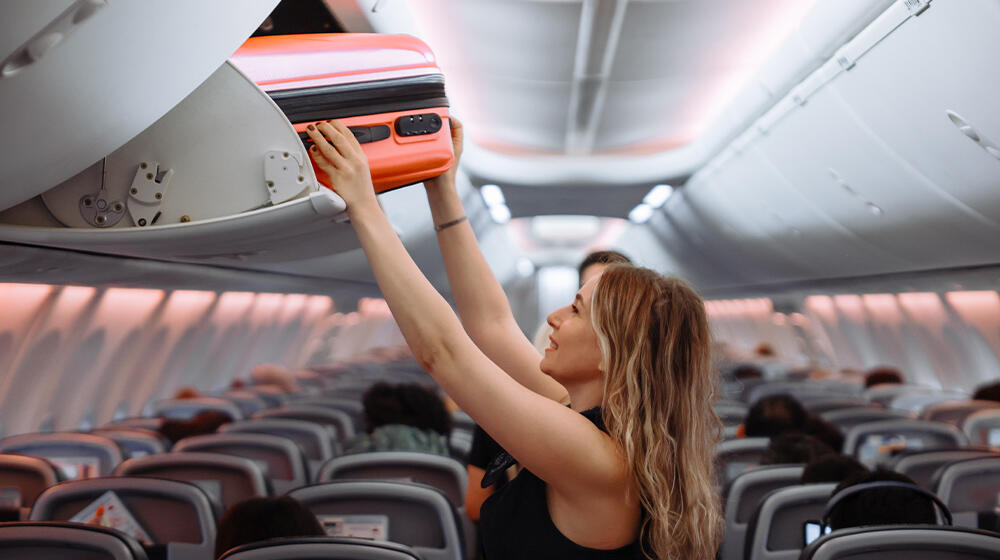
Who hasn’t experienced it: security control or boarding begins — and suddenly there is uncertainty about whether your carry-on baggage really complies with the current rules. Even in 2026, there is no universal answer, as airline guidelines still differ significantly in terms of size, weight, and additional fees.
You may be asking yourself: “Will my trolley fit in the overhead compartment?” or “Will I have to pay extra at the gate for my backpack?”. You are not alone. Although many rules are known, they are implemented differently by airlines and airports. If you know the basics, you can make good decisions — completely stress-free. This guide helps exactly here and provides clear answers so that you can start your short- or long-haul flight well prepared.
What you will know after reading:
- Which carry-on dimensions apply in 2026 for major airlines
- How liquids are regulated in carry-on baggage
- Which items can be problematic
- How to avoid additional costs
- How to get through security calmly
The most important points at a glance
- Carry-on dimensions vary significantly depending on the airline.
- Weight is usually between 8 and 10 kg.
- The 100 ml rule for liquids still applies.
- Dangerous items are strictly prohibited.
- Good preparation saves time, money, and stress.
Which carry-on rules really apply in 2026?
The most important insight first: there is no single rule for all airlines. The international aviation association IATA recommends standard dimensions, but each airline decides for itself. However, in the first half of 2026, the European Parliament adopted a uniform regulation for the coming year: airlines operating in the EU must allow passengers to bring one piece of carry-on baggage free of charge.
For you, this means: if in doubt, check with your airline about the valid dimensions and weight limits for carry-on baggage. Especially with low-cost fares, in 2026 often only one small bag is free of charge.
What dimensions are common?
Many airlines follow the recommended guidelines of the aviation association. If your baggage falls within this range, you are usually on the safe side:
- approx. 56 × 45 × 25 cm as a standard size
- weight limit starts at 5 kg
- a small additional bag is usually allowed
How strict are weight restrictions?
Here as well: each airline has its own maximum carry-on weight. A few hundred grams difference is rarely an issue. However, note that significant excess weight can incur charges. On average:
- 8 kg carry-on baggage
- in some cases 10–15 kg possible
- depending on fare and booking class
- checks at the gate are common
Carry-on baggage dimensions 2026: current specifications of major airlines for download
Download the carry-on guidelines (pdf, 665 KB) for maximum permitted dimensions, weight, and special features of the following airlines: Austrian Airlines, Ryanair (Lauda Europe), Eurowings, Turkish Airlines, Lufthansa, and Wizz Air.
What is allowed in carry-on — and what is not?
There are also guidelines regarding safety on board, specifying which items are allowed, prohibited, or potentially problematic. We show you what to consider so you can pass through security smoothly with your carry-on baggage.
Which liquids are allowed?
Even though more and more airports are introducing modern scanners that screen baggage using computed tomography, the well-known 100 ml rule still applies. This means that liquids may be carried in hand luggage if:
- each container holds a maximum of 100 ml
- all liquids are stored in a 1-liter bag
- the 1-liter bag is transparent
Exceptions are often made only for baby food, milk, and drinking bottles for babies and children up to 3 years old.
Which items are prohibited in carry-on baggage?
Uniform regulations apply to prohibited items. These items belong in checked baggage and are not allowed on board:
- knives and scissors with blade length over 6 cm
- tools such as screwdrivers
- sports equipment such as golf clubs, hiking poles
- flammable or hazardous substances
- weapons and replicas
What is allowed but sometimes tricky?
The following common travel items are often allowed but may be subject to closer inspection. In some cases, they may also be refused, for example if the blade is longer than 6 cm:
- tweezers usually allowed
- disposable razors unproblematic
- small nail scissors usually allowed
- loose razor blades sometimes problematic
- metal nail files sometimes problematic
Our tip: if you are unsure, it is best to put the item in checked baggage or ask in advance.
How can you avoid stress at boarding?
With a few simple tips, you can travel much more relaxed. Plan your carry-on carefully. A packing list helps keep everything under control. Many travelers worry too much — a few clear basic rules are enough:
Practical tips for relaxed travel
- measure and weigh carry-on in advance
- check airline rules in good time
- pack liquids according to the 100 ml rule
- avoid critical items
- arrive at the airport early
Travel relaxed with the right preparation and proper coverage
Carry-on rules in 2026 may seem complicated at first glance — but they are not, if you know the airline requirements for size and weight, the 100 ml rule, and prohibited items. A quick check with your airline when planning your trip provides certainty. This helps you avoid additional costs and unpleasant surprises. Combined with suitable travel insurance, such as our CompleteCover, you are well prepared for your flight, no matter where you are going.
This ensures a stress-free journey and a relaxed holiday with the right preparation and proper coverage.
FAQ
What size can carry-on baggage be?
Standard dimensions are usually around 55 × 40 × 23 cm. Variations are possible.
Is a backpack allowed?
Yes, almost always. A small bag or backpack often counts as a personal item in addition to carry-on baggage.
What happens if baggage is too large?
It is usually checked in for a fee. Low-cost airlines in particular are strict about this.
Can I take tweezers?
Yes, they are generally allowed, as they do not have a dangerous blade.
Are razors allowed?
Disposable razors are unproblematic. Loose razor blades may be objected to.
Why are there no uniform rules?
Airlines set their own regulations, although there are international recommendations.
Is there going to be an EU-wide rule for free carry-on baggage?
In 2026, the European Parliament passed a law: airlines operating in the EU will be required from next year to offer free carry-on baggage.
From our travel magazine